Photo: Chinese Mountains
Mount Sanqing
Sanqing Shan
A quieter Huangshan — granite peaks without the crowds
Information verified: August 2026 — prices and opening status change; recheck official sources before you travel.
Is Mount Sanqing worth it?
Huangshan-grade granite scenery at half the crowd — and half the price
Sanqingshan delivers the classic Chinese granite landscape — spires, twisted pines, sea of clouds — through a mostly flat 3.6km boardwalk suspended along cliff faces. Entry costs CNY 120 versus Huangshan's 230, queues are shorter, and the 72-hour ticket lets you sleep on the mountain for a dawn summit. For travelers who want the look of Huangshan without the stair torture, this is the smarter pick.
You want Huangshan's iconic sunrise infrastructure (Dawn Pavilion, the Welcoming Pine), you are visiting on a Chinese holiday weekend (the narrow boardwalk queues up badly), or you need summit luxury — Sanqing's summit lodgings are basic.
Travelers who want world-class granite scenery with gentle walking, photographers chasing a quieter cloud sea, and anyone building a Jiangxi trip around Wuyuan or Lushan.
About Mount Sanqing
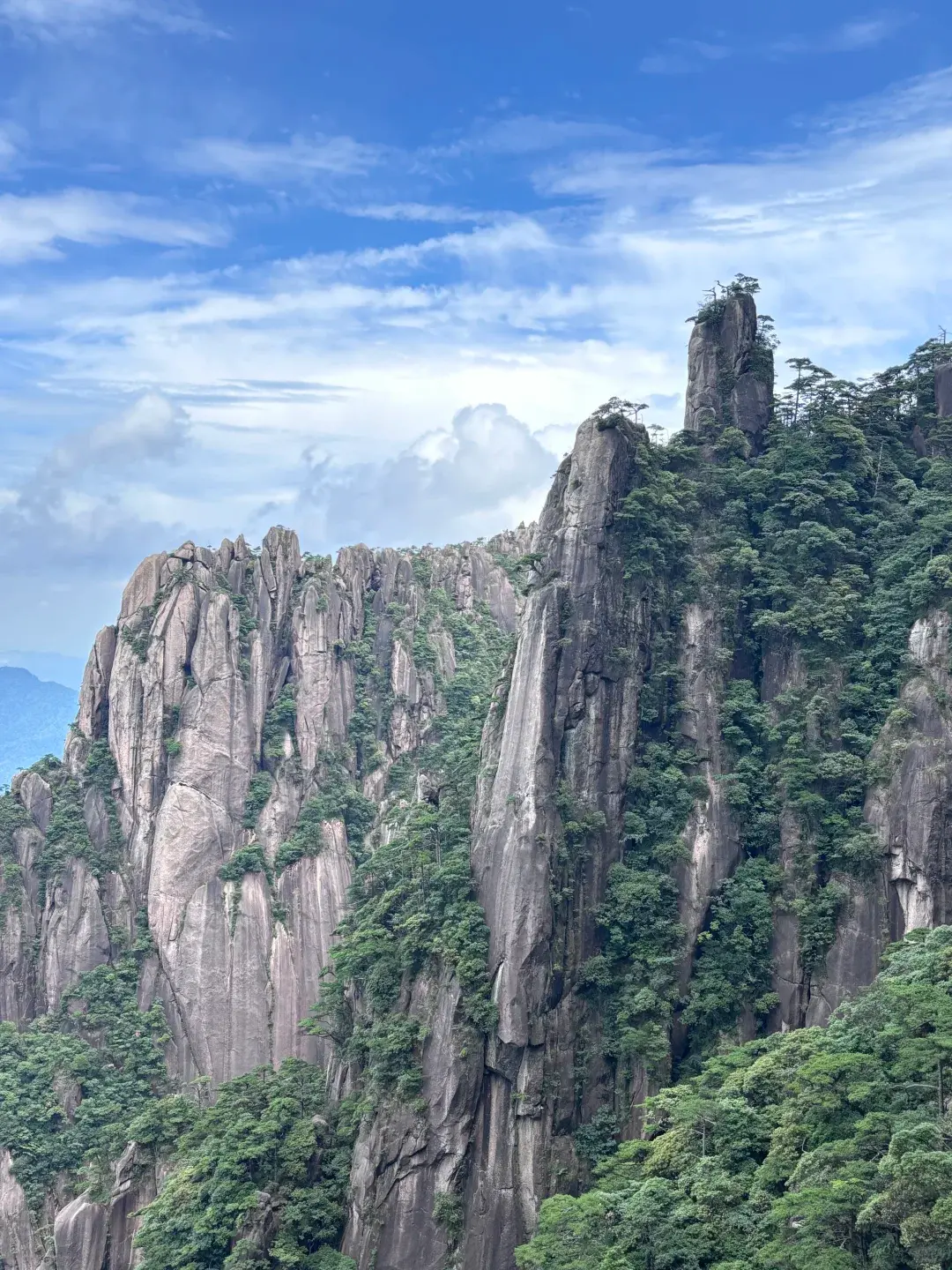
Mount Sanqing (Sanqingshan) in Jiangxi Province is arguably the most underrated mountain in China. Named after the Three Pure Ones — the highest deities in the Daoist pantheon — this UNESCO World Heritage Site (2008) combines the granite spire scenery of Huangshan with far fewer visitors. The mountain features three main peaks — Yujing (1,817m), Yuxu, and Yuhua — surrounded by a fantastical landscape of twisted granite pillars, ancient pine trees growing horizontally from vertical rock faces, and suspended walkways that curl around cliff edges above thousand-meter drops. What sets Sanqing apart is the quality of its hiking infrastructure: a 3,600-meter elevated boardwalk (the West Coast Trail) wraps around the mountain's western face at approximately 1,600m elevation, offering constant, dramatic views with relatively gentle gradients. The East Coast Trail provides a similar experience on the eastern face. Together, these walkways make Sanqing's jaw-dropping scenery accessible to anyone who can walk 3-4 hours — no technical climbing required. The mountain's Daoist heritage runs deep: for over 1,600 years, practitioners have sought solitude here, building temples that seem to grow from the rock. The morning sea of clouds, when the granite spires emerge from mist like islands in a white ocean, rivals Huangshan's famous views — but with a fraction of the crowds. Spring (April-May) for azaleas or autumn (October-November) for crisp visibility are the best seasons.
Mountain Facts
Cultural Significance
UNESCO Geopark. Named after the Three Pure Ones of Daoism. Geologically a sibling to Huangshan but far less visited.
Highlights
- • Goddess of Mercy Peak
- • Python Emerging from the Mountain
- • West Coast cliff trail
- • Sunshine Coast boardwalk
- • Sanqing Temple (1,530m)
Who should go — and who should skip
A quick reality check for six common traveler profiles, based on the real terrain, stairs, and queues.
First-time visitor
GOThe easiest big-scenery mountain in China: flat boardwalks, no climbing required.
Take the 1-day loop: Jinsha cable car up, South Clear Garden (Giant Python, Goddess Peak), Sunshine Coast, West Coast Trail, cable car down. Start before 8 AM to beat the queue. If you can stay one night, the 2-day plan with sunrise at Yujing Peak is worth the extra planning.
Photographer
GOA quieter cloud sea than Huangshan, with sunrise from Yujing Peak (1,819.9m).
Go in October or November — the driest months with the highest visibility. Sleep at a summit hotel and catch sunrise from Yujing Peak or the Goddess Peak platform. Mornings before 10 AM are the clearest window; the 'Sanqing mist' at dawn is the classic shot.
Traveling with kids
IT DEPENDSFlat boardwalks are kid-friendly, but weekend cable car queues are not.
Go on a weekday and arrive at the cable car station by 7:30 AM. The loop itself is smooth walking with guardrails — safe for older kids. Skip the Yujing Peak side trail. Bring snacks: summit food is limited and expensive.
Tight budget
GOCNY 120 entry and CNY 125 cable car — the cheapest big granite mountain in China.
Visit in winter: entry drops to CNY 80 and the cable car to about CNY 110. Stay at a summit dorm bed (CNY 150-300) to avoid a second cable car ride, and bring your own food. The 72-hour ticket means one entry covers two days. Total: roughly CNY 450-550 per person, transport excluded.
Older travelers / knee issues
GOThe most accessible big-mountain scenery in China — flat boardwalk, minimal stairs.
This is the mountain to pick over Huangshan if stairs are a problem. The main loop is level boardwalk; only the side trails to Yujing Peak involve real climbing. Seniors 65+ enter free. Avoid holiday weekends — the walkway itself is easy, but queues and crowd crush are not.
Serious hiker
IT DEPENDSSpectacular, but the boardwalk makes it almost too easy.
Take the traditional Southern cable car (Wai Shuangxi) to feel the pilgrimage route, then add the Yujing Peak side trail (the highest point, about 1.5h round trip from the West Coast Trail). For a real workout, hike up from Wai Shuangxi (2-3h of stairs) and descend by cable car — but the ascent has few views, so most hikers skip it.
Which route should you take?
All the ways up and around, compared side by side so you don't have to open five pages.
| Route | Time | Cost | Difficulty | Scenery | Best for |
|---|---|---|---|---|---|
| Jinsha cable car (west side) Recommended Jinsha service area, west side · Cable car | 8-10 min | CNY 125 round trip | Easy | ★★★★★ | The default choice — recommended for first-timers and day-trippers |
| Wai Shuangxi cable car (south side) Wai Shuangxi, south side · Cable car | 8-10 min | CNY 120 round trip | Easy | ★★★★★ | Hikers doing the full loop in the opposite direction, or visitors wanting the quieter entrance |
| Summit loop boardwalk (South Clear Garden + Sunshine Coast + West Coast) From either cable car station, up at the summit · Hike | 4-6 hours full loop | Included in entry (no extra charge) | Moderate | ★★★★★ | Everyone — this IS the Sanqingshan experience, not an optional extra |
| Full hike from the base Wai Shuangxi or Jinsha trailhead · Hike | 2-3 hours up (about 1,200m of stairs) | Free (saves the CNY 120-125 cable car) | Hard | ★★★★★ | Only budget hikers who genuinely want the workout; not recommended for most visitors |
Jinsha cable car (west side)
RecommendedJinsha service area, west side · Cable car
- +Fastest access to the main summit loop and South Clear Garden
- +Delivers you to the start of the classic one-way loop
- +Larger station with more buses and hotels below
- –Longest queues in peak season — up to 2-4 hours on holiday weekends
- –You skip the traditional pilgrimage approach
Best for: The default choice — recommended for first-timers and day-trippers
Wai Shuangxi cable car (south side)
Wai Shuangxi, south side · Cable car
- +Serves the traditional pilgrimage route to Sanqing Temple
- +Usually shorter queues than Jinsha
- +Milder winter operation schedule
- –Slightly longer walk to the main South Clear Garden area
- –Fewer hotels and restaurants at the base
Best for: Hikers doing the full loop in the opposite direction, or visitors wanting the quieter entrance
Summit loop boardwalk (South Clear Garden + Sunshine Coast + West Coast)
From either cable car station, up at the summit · Hike
- +The 3.6km suspended boardwalk — flat, wide, safe, with constant cliff views
- +Covers every major viewpoint: Giant Python, Goddess Peak, Sunshine Coast, West Coast Trail
- +Mostly level — no technical climbing required
- –Narrow in sections — single-file when crowded
- –Loop direction matters for light: do it clockwise to face the sun in the morning
Best for: Everyone — this IS the Sanqingshan experience, not an optional extra
Full hike from the base
Wai Shuangxi or Jinsha trailhead · Hike
- +Saves the cable car fare
- +Quiet trail
- –Trees block almost all views for the first 2 hours
- –1,200m of relentless stone stairs — the mountain's own guidebook discourages it
- –Arriving exhausted means enjoying the boardwalk less
Best for: Only budget hikers who genuinely want the workout; not recommended for most visitors
Plan your trip: day-by-day
Three tested ways to see the mountain, from a rushed day trip to a full canyon expedition. Switch tabs to compare.
The classic one-day loop
Most visitors — the loop is compact enough for a full day- 07:30
Jinsha cable car up
30 minBeat the queues with the first cable cars. Land at the summit loop entrance.
- 08:30
South Clear Garden
2 hThe star views: Giant Python Emerging from the Mountain and the Goddess of the East, with pines on granite in every direction.
- 11:00
Sunshine Coast boardwalk
1.5 hThe eastern cliff trail — mostly flat, with views over the Jade Capital peaks. Grab lunch at a summit vendor (CNY 40-60).
- 13:00
West Coast Trail
2 hThe most dramatic section — boardwalk curling around cliff faces above thousand-meter drops. Watch the afternoon light on the granite spires.
- 15:30
Return via Yujing junction and cable car down
1.5 hOptional 1.5h side trip up Yujing Peak (1,819.9m) from the West Coast midpoint. Otherwise descend by cable car and bus back to Shangrao.
Editor's note: One day works well because the loop is flat and compact. You miss sunrise and the mountain's famous dawn mist — if the forecast is clear, the 2-day plan is meaningfully better.
Where to stay: summit or base?
The single biggest decision of the trip is not which route — it is whether you sleep on the mountain. Here is the honest trade-off.
Sunrise Hotel (Rishan Zhuang)
- +Closest summit hotel to the Yujing Peak sunrise trail
- +Dorm beds cheap enough to justify the overnight
- +Heated dining hall for dinner
- –Rooms are basic — think mountain lodge, not hotel
- –Books out on holiday weekends
Best for: Sunrise chasers and budget travelers
Goddess Hotel (Nüshen Binguan)
- +Sits at the edge of South Clear Garden — steps from the Giant Python
- +Easier booking than Sunrise Hotel on weekdays
- –Facilities are older
- –No direct trail access to Yujing Peak
Best for: First-timers who want to wake up inside the main scenery
Sanqing Temple guesthouse
- +The cheapest summit sleep in China's big mountains
- +A genuinely atmospheric stay beside the 1,600-year-old Daoist temple
- –Very basic — shared bathrooms, thin walls
- –Far from the cable car stations; carry your own water
Best for: Backpackers and the truly budget-minded
Jinsha town (base)
- +30-40% cheaper than summit rooms
- +Restaurants and shops right at the cable car station
- +Comfortable modern rooms
- –You miss the dawn entirely
- –Adds 30-40 min of cable car + queues each morning
Best for: Comfort-first travelers who accept missing sunrise
What it really costs
Straight price ranges for a per-person trip — three tested styles and every charge spelled out. No math required.
Budget
2 daysDorm beds, bring your own food
~CNY 520
per person
- •Peak entry CNY 120 (72h valid)
- •Cable car round trip CNY 125
- •Summit dorm bed CNY 200
- •Bring-your-own food ~CNY 50
- •Winter drops this to ~CNY 400
Mid-range
2 daysPrivate room shared by two
~CNY 800
per person
- •Peak entry CNY 120
- •Cable car round trip CNY 125
- •Summit private room CNY 500 (shared by 2)
- •Meals at summit vendors CNY 180
Premium
2 daysBest rooms, everything included
~CNY 1,000
per person
- •Peak entry CNY 120
- •Cable car round trip CNY 125
- •Best summit room CNY 700 (shared by 2)
- •Restaurant meals + snacks CNY 260
- •Combine with Wuyuan for a full Jiangxi trip
Price at a glance
Every charge on the mountain, spelled out — no calculator needed.
Note: Excludes the CNY 27 bus from Shangrao Station. Off-peak (Dec-Feb) saves CNY 40 on entry and about CNY 15 on the cable car. Summit food is limited — packing your own lunch cuts CNY 50-100 per day.
When to go: the season trade-offs
Every season works — but each one is a different mountain. Pick the row that matches your priorities.
| Season | Weather | Views | Crowds | Score |
|---|---|---|---|---|
| Spring March-May | 5-20 C, azalea blooms, frequent mist | Pink azaleas against grey granite; cloud seas common in May-June after rain Azalea season turns mid-elevation slopes pink — a rare combination with granite spires | Manageable | ★★★★★ |
| Summer June-August | 15-28 C, warm and wet, heavy morning mist | Mist often hides the pillars until mid-morning; post-storm clarity can be stunning Greenest season with dramatic storm light — but the fog gamble is real | Crowded | ★★★★★ |
| Autumn September-November | 8-20 C, driest months of the year | Highest visibility and the famous 'Sanqing mist' at sunrise — the classic season Crisp air, golden valley colors, and the year's best sea-of-clouds odds — avoid Golden Week (Oct 1-7) | Manageable | ★★★★★ |
| Winter December-February | -5 to -10 C at the summit, snow and rime ice | Rime ice coats the granite spires and pines — a starkly beautiful, near-empty landscape Entry drops to CNY 80 and the cable car shortens its hours — check the schedule; the reward is a private mountain | Quiet | ★★★★★ |
Spring
★★★★★March-May
5-20 C, azalea blooms, frequent mist
Pink azaleas against grey granite; cloud seas common in May-June after rain
Azalea season turns mid-elevation slopes pink — a rare combination with granite spires
Summer
★★★★★June-August
15-28 C, warm and wet, heavy morning mist
Mist often hides the pillars until mid-morning; post-storm clarity can be stunning
Greenest season with dramatic storm light — but the fog gamble is real
Autumn
★★★★★September-November
8-20 C, driest months of the year
Highest visibility and the famous 'Sanqing mist' at sunrise — the classic season
Crisp air, golden valley colors, and the year's best sea-of-clouds odds — avoid Golden Week (Oct 1-7)
Winter
★★★★★December-February
-5 to -10 C at the summit, snow and rime ice
Rime ice coats the granite spires and pines — a starkly beautiful, near-empty landscape
Entry drops to CNY 80 and the cable car shortens its hours — check the schedule; the reward is a private mountain
How it compares with similar mountains
Straight answers to the comparisons travelers actually search for — no need to open five tabs.
Sanqingshan vs Huangshan: same granite DNA, half the crowds
Mount Huangshan details →- • Both are UNESCO granite-spire landscapes with pines, mist, and sea-of-clouds sunrises — geologically, Sanqingshan is the quieter sibling of Huangshan
- • Sanqingshan's summit loop is a flat 3.6km boardwalk; Huangshan demands hours of stone stairs between viewpoints
- • Entry costs CNY 120 vs 230, and the 72-hour ticket is built for overnighting
- • Huangshan has the better sunrise infrastructure (Dawn Pavilion) and the iconic Welcoming Pine; Sanqingshan has roughly half the visitor volume
- • Pairing: Huangshan goes with Hongcun; Sanqingshan goes with Wuyuan or Lushan
Our verdict: Pick Huangshan for the icon and the sunrise; pick Sanqingshan for the same style of landscape with gentler walking, shorter queues, and a smaller bill.
Sanqingshan vs Zhangjiajie: granite spires vs sandstone pillars
Zhangjiajie National Forest Park details →- • Zhangjiajie's quartz-sandstone pillars are taller and stranger (the Avatar look); Sanqingshan's weathered granite is subtler and more classical
- • Zhangjiajie is a sprawling multi-zone park needing 3+ days; Sanqingshan is a compact 1-2 day loop
- • Zhangjiajie averages 110,000 visitors a day; Sanqingshan is a fraction of that even in peak season
- • Both are cheap by Chinese standards: 228/120 for entry, with cable cars around 72-125
- • Sanqingshan is walkable (flat boardwalks); Zhangjiajie is viewpoint-hopping by elevator and cable car
Our verdict: Short on time or allergic to crowds: Sanqingshan. You want the alien Avatar landscape and can commit 3+ days: Zhangjiajie.
Sanqingshan vs Lushan: Jiangxi's scenery vs Jiangxi's soul
Mount Lushan details →- • Lushan is a gentle cultural retreat — poetry, villas, mist, and lake views; Sanqingshan is a granite spectacle with real (if easy) walking
- • Lushan's ticket covers 7 days of sights including museums and villages; Sanqingshan's 72-hour ticket covers one mountain loop
- • Summer: Lushan is a famous heat-escape; Sanqingshan is foggy and wet in July-August
- • Both pair perfectly with each other — they are 2.5h apart and make a natural Jiangxi double-header
Our verdict: Culture, ease, and summer cool: Lushan. Granite scenery and a proper mountain feel: Sanqingshan. Do both if your itinerary allows — they complement rather than compete.
Editor's pro tips
Arrive at the Jinsha cable car by 7:30 AM on weekends — queues hit 2-4 hours between 9 and 11 AM.
The 72-hour ticket is designed for overnighting: one entry covers two days, so sleep on the mountain and catch dawn.
Walk the loop clockwise (South Clear Garden → Sunshine Coast → West Coast) to keep the sun at your back in the morning.
The Yujing Peak side trail is easy to miss — it branches off the West Coast midpoint. About 45 min each way, with chains on the last scramble.
Sanqingshan runs regular free-ticket promotions for residents of certain provinces and cities (Jiangxi, Hunan/Hubei, the 'furnace cities', Shandong/Henan in 2026) — check the official 'Sanqingshan Smart Tourism' mini-program before booking.
All tickets are online-only real-name reservations — there is no walk-up window. Book 1-3 days ahead.
Hiking up from the base is 2-3 hours of viewless stairs; even the park's own guide recommends the cable car.
Pair with Wuyuan's villages (1.5h drive) or Lushan (2.5h) for the classic Jiangxi circuit.
Packing checklist
How to Get There
By Air: Fly to Shangrao Sanqingshan Airport (SQD, opened 2019) or to Nanchang Changbei International Airport (3h drive). By High-Speed Train: Shangrao Station on the Shanghai-Kunming line is the main gateway (2h from Hangzhou, 2.5h from Shanghai). From Shangrao Station, direct buses to the scenic area take 1.5-2 hours (CNY 27). Getting up the mountain: two cable cars — the Southern Cable Car (from Wai Shuangxi, 40 min line in peak season) and the Western Cable Car (from Jinsha, faster access to the main loop). Both cost CNY 125 round trip on top of the CNY 120 entry. The 3.6km suspended boardwalk loop around the summit area is mostly flat and takes 3-4 hours at a relaxed pace. Entry Fee: CNY 120 (peak), CNY 80 (low season).
Frequently Asked Questions
Is Mount Sanqing worth visiting? +
What is the best time to visit Sanqing? +
How do I get to Mount Sanqing? +
How difficult is hiking Mount Sanqing? +
What should I bring for Sanqing? +
You May Also Like
Mount Huangshan
Huang Shan · Anhui
China's most iconic peaks — sea of clouds and granite spires
Mount Lushan
Lu Shan · Jiangxi
The mountain of poets, mist, and colonial villas — 1,500 years of inspiration
Mount Tai
Tai Shan · Shandong
The most sacred mountain — climbed by emperors for 3,000 years