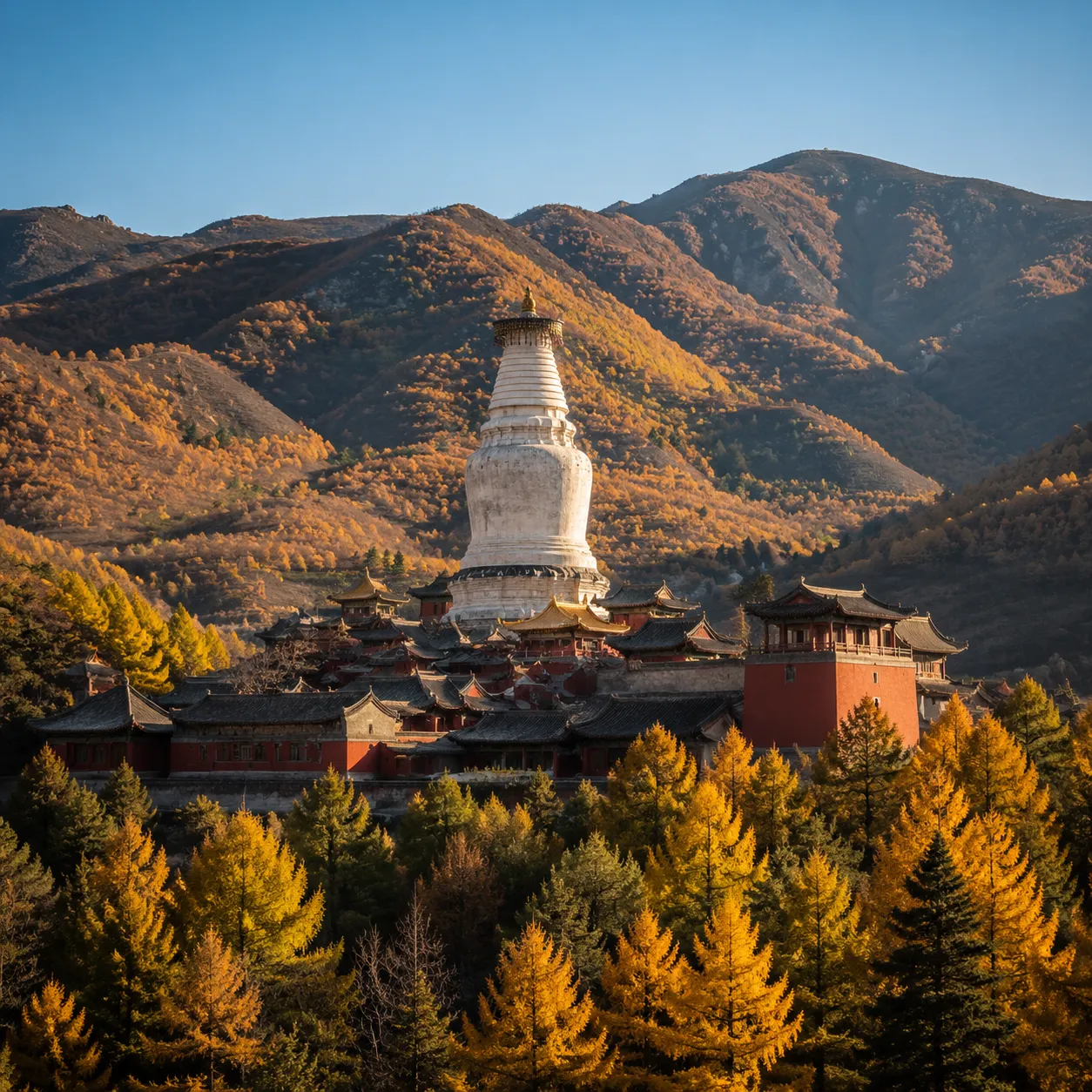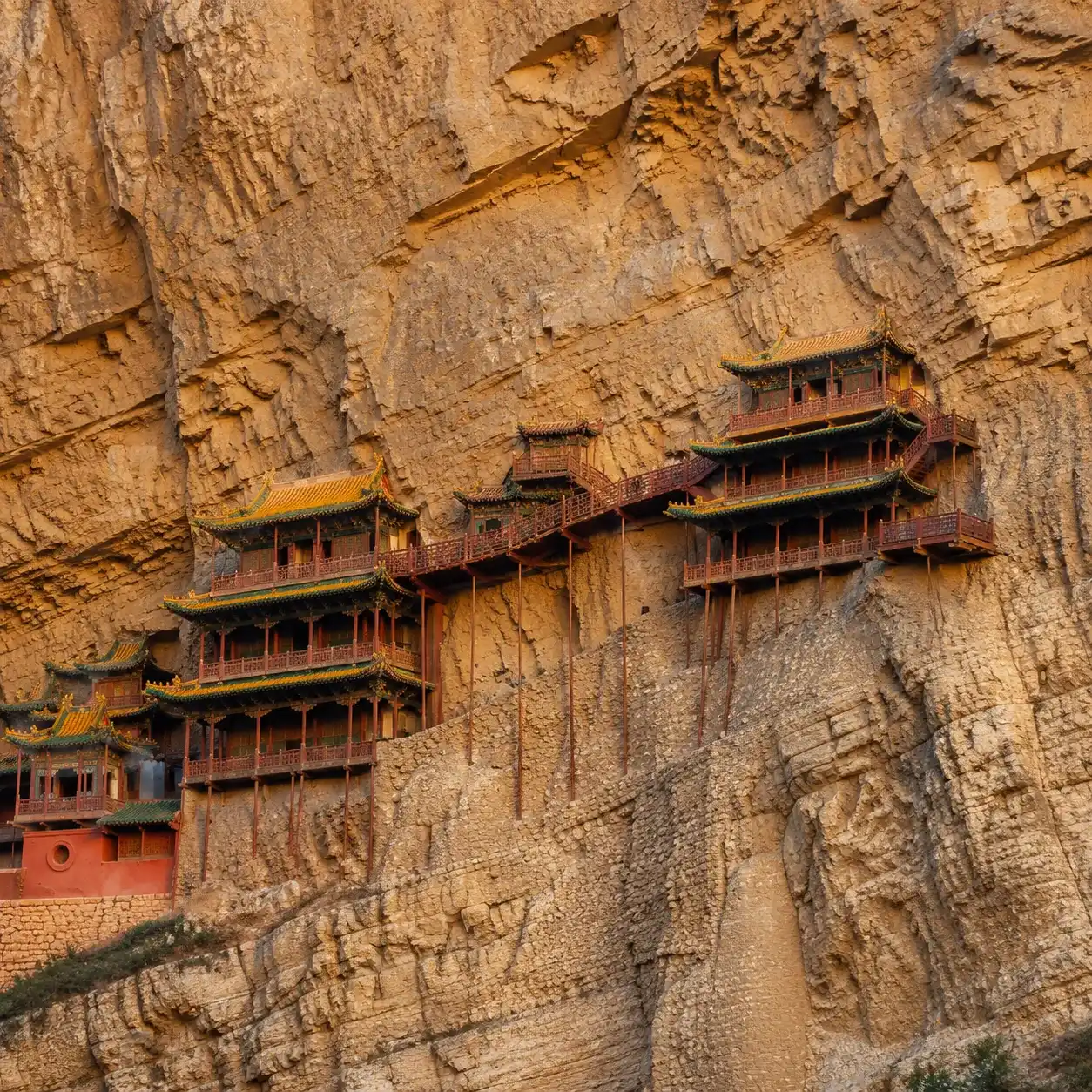
Photo: Chinese Mountains
Mount Heng (Shanxi)
Heng Shan (Shanxi)
Home to the mind-bending Hanging Temple suspended from a sheer cliff
About Mount Heng (Shanxi)
Mount Heng (Hengshan) in Shanxi Province — the Northern Great Mountain (Beiyue) — is best known for a single architectural miracle: the Hanging Temple (Xuankong Si). Built into a sheer cliff face 75 meters above the ground, this 1,500-year-old monastery appears to float in mid-air, supported by wooden beams wedged into holes chiseled in the rock. The temple is unique in Chinese religious architecture — it is the only surviving temple dedicated to all three of China's major philosophical traditions: Buddhism, Daoism, and Confucianism, with halls and statues for each faith arranged across 40 rooms connected by narrow wooden walkways and bridges. Standing on the outer corridors, with only a wooden railing between you and a vertical drop to the valley floor, it is easy to understand why the temple has been called one of the most dangerous buildings in the world — though the structure is remarkably stable, having survived 1,500 years of earthquakes. The mountain itself is a geological curiosity: horizontal sedimentary strata tilted nearly vertical by tectonic forces create dramatic canyon walls with alternating bands of color. The main peak, Hengshan Summit, reaches 2,017 meters. The hiking route passes through several active Daoist temples where monks maintain centuries-old traditions. Mount Heng is the least visited of the Five Great Mountains, largely due to its relatively remote location in northern Shanxi, but this isolation is precisely its appeal — you are more likely to share the Hanging Temple with a handful of other visitors than with tour bus crowds. The mountain is reachable from Datong (1.5 hours by bus), which is connected to Beijing by high-speed train (2 hours).
Mountain Facts
Cultural Significance
The Northern Great Mountain, famous for the 1,500-year-old Hanging Temple that uniquely combines Buddhist, Daoist, and Confucian worship.
Highlights
- • The Hanging Temple
- • Hengzong Temple
- • Heavenly Peak summit
- • Tianfeng Ridge
- • Huixian Cliff
When to Go
May-June and September-October offer the best balance: 10-25 C, dry trails, and clear views from Tianfeng Ridge (2,016.1m). Summer (July-August) is warm (up to 30 C) and this is the busiest season, with the Hanging Temple queues peaking; mornings before 9 AM are essential. The view from the ridge after summer rain — clouds rolling through the canyons below — is the mountain's signature sight. Autumn (September-November) is the photographers' window: golden foliage on the slopes, crisp air, and the Hanging Temple glowing in low light. Winter (December-February) is cold (-5 to 10 C) and often windy; the Hanging Temple stays open but the upper mountain paths can ice over — bring crampons if hiking. The temple is best photographed at opening time (8 AM) when the light hits its southern facade.
How to Get There
By Air: Fly to Datong Yungang Airport (DAT) — direct flights from Beijing, Shanghai, Guangzhou, and Xi'an. From the airport, the Hanging Temple (Xuankong Si) is about 1.5 hours by road (70km) to Hunyuan County. By High-Speed Train: Datong South Station on the Beijing-Zhangjiakou-Datong line (2h from Beijing) or the Datong-Taiyuan line. From Datong South, buses and taxis reach Hunyuan County (1-1.5 hours, CNY 30-60). The Hanging Temple sits on the cliff road between Hunyuan and Mount Heng's main gate — buses to the mountain pass the temple. To reach the ridge: from the main gate, shuttle buses climb to the cable car station; the cable car (CNY 70 round trip) or a 2-hour stone-step climb reaches the summit area. Entry Fee: Hanging Temple CNY 115; Mount Heng CNY 45; cable car extra.